cd ~/projects/blitzcode
BlitzCode
A competitive coding platform with single-player quizzes, real-time multiplayer matches, an in-platform DSA editor, and personalized coding profile integrations.
- status
- Live
- concept
- Queues, WebSockets, Code Judge, LLM APIs
- repository
- BlitzCode on GitHub
overview
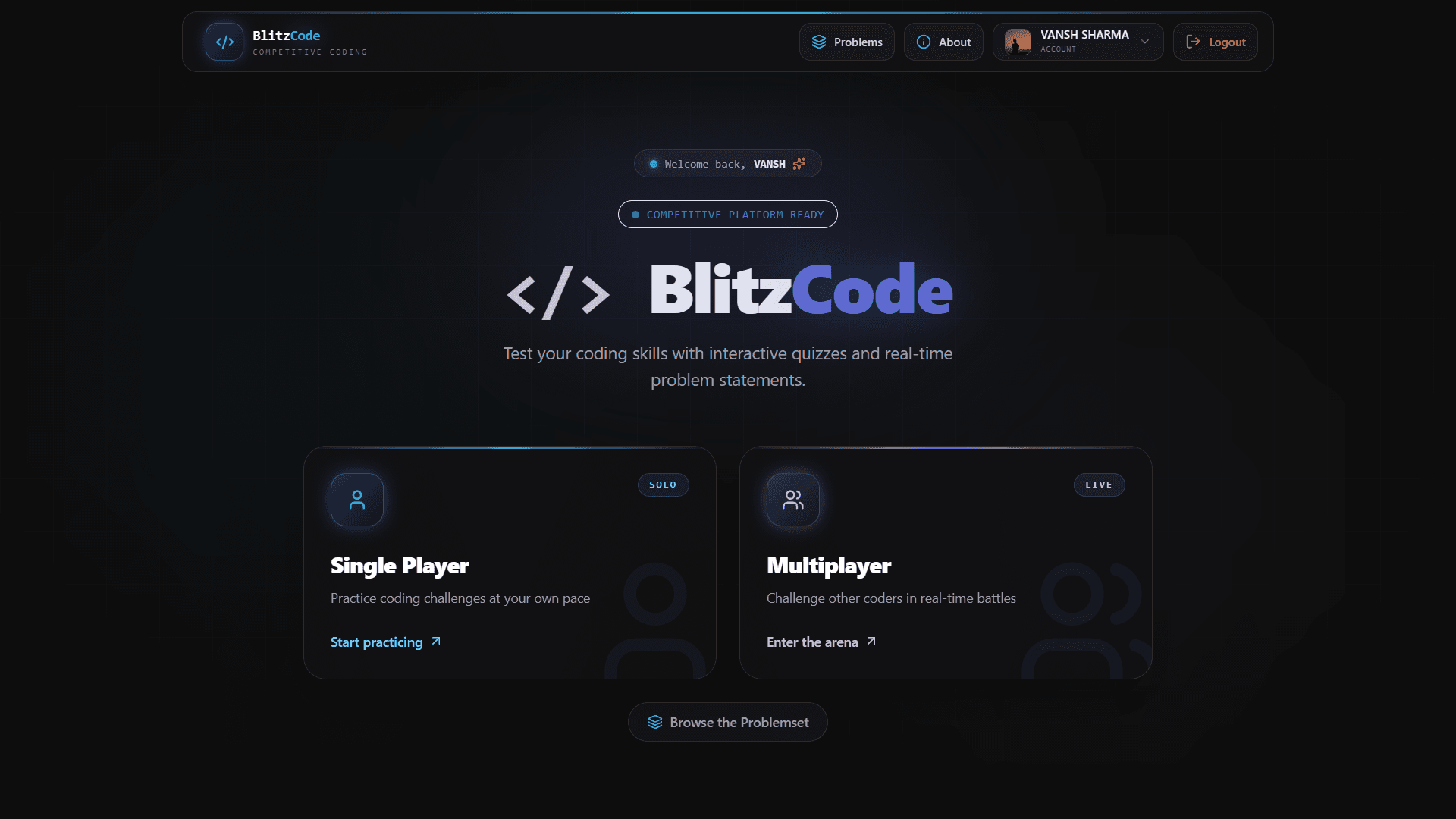
BlitzCode brings coding practice and competition together. Choose a single-player quiz or match with another player in real time. Multiplayer matchmaking pairs players who selected the same quiz options. If the question bank is short for a selected combination, background workers can use an LLM to generate more questions and store them for future play.
For deeper practice, solve from a collection of nearly 3,000 DSA problems, with Codeforces ratings across different concepts. Write code in the built-in editor, run it against public test cases, and submit it against private test cases. After submission, review a graph of your solution’s time and space complexity. Personalized LeetCode and Codeforces profile integrations bring your coding activity together.
stack
// what BlitzCode is built withconst stack = {frontend: ["React", "TypeScript"],backend: ["Next.js API Routes", "TypeScript"],queuesCache: ["BullMQ", "Redis", "localStorage"],api: ["gemini", "deepseek", "mistral", "judgeO", "codeforces", "leetcode"],database: ["Postgresql", "Drizzle ORM"],tools: ["NextAuth", "Bun", "WebSockets"],} ; export default stack;preview1 file
how it works
Choose how to play
Select single-player to practice on your own, or multiplayer to compete against another player in a real-time match.
Get a quiz
In single-player mode, BlitzCode fetches questions from the backend based on your selections and displays them for you to play.
Match with another player
In multiplayer mode, BlitzCode connects over WebSockets and looks for another player who selected the same quiz options. Once matched, both players play in real time.
Generate questions when needed
If the database has too few questions for a selected combination of options, background workers can ask an LLM to generate new questions and save them to the database.
Practice DSA problems
Choose from nearly 3,000 problems, write a solution in the editor, run it against public test cases, and submit it against private test cases.
features7 total
Single-player quizzes
Fetch questions based on your selected options and practice at your own pace.
Real-time multiplayer
Compete live with another player through WebSocket matchmaking that pairs players with the same selected quiz options.
LLM-generated questions
When the question bank is short for a selected combination, workers can generate and store new questions using an LLM.
A large DSA problem library
Practice with nearly 3,000 problems, rated by Codeforces difficulty and covering different concepts.
In-platform code editor
Write and run solutions without leaving BlitzCode. Test against public cases, then submit against private test cases.
Complexity graphs
After submitting a problem, view a graph of your solution’s time and space complexity.
LeetCode and Codeforces integrations
Connect your profiles to bring your coding activity and BlitzCode progress together.
problems & fixes
Keeping multiplayer matches fair
Problem: Players need to compete on equivalent quizzes for a multiplayer match to be fair.
Solution: WebSocket matchmaking pairs players who selected the same quiz options before starting a real-time game.
Not enough questions for every quiz combination
Problem: The question bank may not have enough questions for a particular combination of selected options.
Solution: Background workers can request new questions from an LLM and store them in the database for use in quizzes.
Handling LLM failures and token limits
Problem: An LLM provider may fail or reach its token limit while generating a question.
Solution: Use three LLM API keys with fallback between providers so generation can continue when one provider fails or reaches its limit.
Processing many question-generation jobs
Problem: A burst of jobs to generate or store questions can overwhelm a single worker.
Solution: Run multiple concurrent workers so jobs can be processed in parallel.